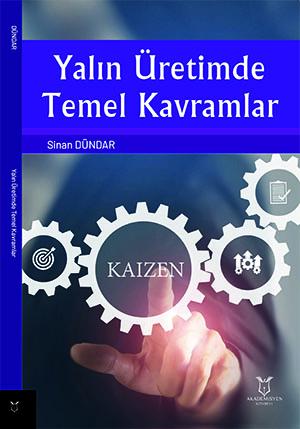
Yalın Üretimde Temel Kavramlar
Özet
Sinan Dündar tarafından kaleme alınan ve Akademisyen Yayınevi tarafından yayımlanan Yalın Üretimde Temel Kavramlar, iş dünyasında sürdürülebilirliği sağlamak, süreçlerdeki israfları ortadan kaldırmak ve operasyonel verimliliği en üst düzeye çıkarmak isteyenler için kapsamlı bir başvuru kaynağı niteliğindedir. Kitap, kökenleri Henry Ford'un seri üretim anlayışına ve Toyota Üretim Sistemi'ne dayanan yalın felsefenin tarihsel gelişimini; Sakichi Toyoda, Taiichi Ohno, Shigeo Shingo ve James P. Womack gibi öncü isimlerin vizyoner katkıları eşliğinde incelemektedir. Eserde; müşteri odaklı değer tanımı, yedi temel israf (muda), muri, mura, Tam Zamanında Üretim (JIT), takt süresi, çevrim süresi, çekme sistemi, otonomasyon (Jidoka) ve Poka-Yoke gibi temel yalın kavramlar ayrıntılı şekilde açıklanmaktadır. Bununla birlikte 5S, Toplam Ekipman Verimliliği (OEE), Toplam Üretken Bakım (TPM), hücresel üretim, Kanban, CONWIP, Değer Akış Haritalama (VSM), Heijunka, SMED, PUKÖ döngüsü ve FMEA gibi güçlü operasyonel araçların yanı sıra süreç iyileştirmede hayati önem taşıyan yedi klasik ve yedi yeni istatistiksel yöntem sistemli bir yapıda okuyucuya aktarılmaktadır. Hem akademisyenler, mühendislik ve işletme öğrencileri hem de kurumlarında yalın dönüşümü gerçekleştirmek isteyen yöneticiler ve uygulayıcılar için ideal bir rehber olan bu kitap, teorik temeller ile pratik uygulama araçlarını birleştiren değerli bir eserdir.
"Basic Concepts in Lean Production", written by Sinan Dündar and published by Akademisyen Yayınevi, serves as a comprehensive reference guide for those seeking to ensure sustainability, eliminate waste in processes, and maximize operational efficiency in the business world. The book examines the historical evolution of lean philosophy rooted in Henry Ford's mass production approach and the Toyota Production System, alongside the visionary contributions of pioneers such as Sakichi Toyoda, Taiichi Ohno, Shigeo Shingo, and James P. Womack. Core lean concepts—including customer-focused value definition, seven basic wastes (muda), muri, mura, Just-in-Time (JIT) production, takt time, cycle time, pull system, jidoka (autonomation), and poka-yoke—are explained in detail. Furthermore, powerful operational tools such as 5S, Overall Equipment Effectiveness (OEE), Total Productive Maintenance (TPM), cellular manufacturing, Kanban, CONWIP, Value Stream Mapping (VSM), Heijunka, SMED, PDCA cycle, and FMEA, as well as the seven basic and seven new statistical methods crucial for process improvement, are presented in a systematic structure. Serving as an ideal guide for academics, engineering and business students, as well as managers and practitioners aiming to implement lean transformation, this book bridges theoretical foundations with practical application tools.
Referanslar
Albright, S. C. ve Winston, W. L. (2020). Business Analytics: Data Analysis and Decision Making (7. bs.). USA: Cengage Learning Inc.
Allen, T. T. (2006). Introduction to Engineering Statistics and Six Sigma: Statistical Quality Control and Design of Experiments and Systems. UK: Springer.
Allen, T. T. (2010). Introduction to Engineering Statistics and Lean Sigma: Statistical Quality Control and Design of Experiments and Systems (2. bs.). USA: Springer.
Andersen, B. ve Fagerhaug, T. (2006). Root Cause Analysis: Simplified Tools and Techniques (2. bs.). Milwaukee: ASQ Quality Press.
Anderson, D. R., Sweeney, D. J., Williams, T. A., Camm, J. D., Cochran, J. J., Fry, M. J. ve Ohlmann, J. W. (2016). An Introduction to Management Science: Quantitative Approaches to Decision Making (14. bs.). USA: Cengage Learning Inc.
Balakrishnan, N., Render, B. ve Stair, R. M. (2014). Managerial Decision Modeling with Spreadsheets (3. bs.). USA: Pearson Education.
Bass, I. (2007). Six Sigma Statistics with Excel and Minitab. USA: McGraw-Hill Companies.
Bass, I. ve Lawton, B. (2009). Lean Six Sigma Using SigmaXL and Minitab. USA: McGraw-Hill Companies.
Basu, R. ve Wright, N. (2003). Quality Beyond Six Sigma. UK: Elsevier Science.
Bauer, J. E., Duffy, G. L. ve Westcott, R. T. (2006). The Quality Improvement Handbook (2. bs.). Milwaukee: ASQ Quality Press.
Black, K. (2010). Business Statistics for Contemporary Decision Making (6. bs.). USA: WILEY.
Borror, C. M. (2009). The Certified Quality Engineer Handbook (3. bs.). Milwaukee: ASQ Quality Press.
Bryman, A. ve Cramer, D. (1996). Quantitative Data Analysis with Minitab. UK: Routledge.
Buglear, J. (2005). Quantitative Methods for Business. UK: Elsevier Ltd.
Cintas, P. G., Almagro, L., Tort, X. ve Llabres, M. (2012). Industrial Statistics with Minitab. UK: WILEY.
Davis, J. W. (2011). Progressive Kaizen: The Key to Gaining a Global Competitive Advantage. USA: Productivity Press.
Dewar, D. L. (1980). Quality Circle: Leader Manual and Instructional Guide. USA: Quality Circle Institute.
Dodge, Y. (2008). The Concise Encyclopedia of Statistics. Almanya: Springer.
Duffy, G. L. (2013). The ASQ Quality Improvement Pocket Guide. Milwaukee: ASQ Quality Press.
Eckes, G. (2003). Six Sigma for Everyone. USA: WILEY.
Evans, J. R. (1991). Statistical Process Control for Quality Improvement. USA: Prentice Hall.
Feld, W. M. (2001). Lean Manufacturing: Tools, Techniques and How to Use Them. Lean Manufacturing: Tools, Techniques and How to Use Them içinde . USA: CRC Press.
Freedman, D., Pisani, R. ve Purves, R. (2007). Statistics (4. bs.). USA: W.W. Norton & Company.
George, M. L., Rowlands, D., Price, M. ve Maxey, J. (2005). The Lean Six Sigma Pocket Toolbook. USA: McGraw-Hill Companies.
Gupta, B. C. (2021). Statistical Quality Control Using Minitab, R, JMP, and Python. USA: WILEY.
Gupta, B. C. ve Walker, H. F. (2007). Statistical Quality Control for the Six Sigma Green Belt. Milwaukee: ASQ Quality Press.
Hamel, M. R. (2010). Kaizen Event Fieldbook: Foundation, Framework, and Standard Work for Effective Events. Michigan: Society of Manufacturing Engineers.
Harrington, H. J. (2017). Lean TRIZ: How to Dramatically Reduce Product-Development Costs with This Innovative Problem-Solving Tool. USA: CRC Press.
Harvey, S. (2019). Kaizen: The Japanese Method for Transforming Habits, One Small Step at a Time. UK: Bluebird.
Heagney, J. (2012). Fundamentals of Project Management (4. bs.). USA: Amacom.
Hirano, H. (1990). 5 Pillars of the Visual Workplace. Japan: Productivity Press.
ILO. (2017). Lean Manufacturing Techniques for Textile Industry. Egypt: International Labour Organization.
Imai, M. (1986). Kaizen: The Key to Japan’s Competitive Success. USA: McGraw-Hill Companies.
Imai, M. (2012). Gemba Kaizen: A Commonsense Approach to a Continuous Improvement Strategy (2. bs.). USA: McGraw-Hill Companies.
Jones, E. C. (2014). Quality Management for Organizations Using Lean Six Sigma Techniques. USA: CRC Press.
Kato, I. ve Smalley, A. (2011). Toyota Kaizen Methods: Six Steps to Improvement. New York: CRC Press.
Kenett, R. S., Zacks, S. ve Amberti, D. (2021). Modern Industrial Statistics with Applications in R, MINITAB and JMP (3. bs.). Italy: WILEY.
Ledbetter, P. (2018). The Toyota Template: The Plan for Just-in-Time and Culture Change Beyond Lean Tools. USA: CRC Press.
Lesik, S. A. (2019). Applied Statistical Inference with MINITAB® (2. bs.). USA: CRC Press.
Levine, D. M. (2006). Statistics for Six Sigma Green Belts with Minitab® and JMPTM. USA: Pearson Education.
Levine, D. M., Stephan, D. F. ve Szabat, K. A. (2021). Statistics for Managers Using Microsoft® Excel® (9. bs.). USA: Pearson Education.
Liker, J. K. ve Meier, D. (2006). The Toyota Way Fieldbook: A Practical Guide for Implementing Toyota’s 4Ps. USA: McGraw-Hill Companies.
Mann, D. (2005). Creating a Lean Culture: Tools to Sustain Lean Conversions. USA: Productivity Press.
Martin, K. ve Osterling, M. (2007). The Kaizen Event Planner: Achieving Rapid Improvement in Office, Service, and Technical Environments. New York: Productivity Press.
McClave, J. T., Benson, P. G. ve Sincich, T. (2018). Statistics for Business and Economics. USA: Pearson Education.
McLoughlin, C. ve Miura, T. (2018). True Kaizen: Management’s Role in Improving Work Climate and Culture. USA: CRC Press.
Mendenhall, W., Beaver, R. J. ve Beaver, B. M. (2020). Introduction to Probability and Statistics (15. bs.). USA: Cengage Learning Inc.
Mika, G. (2006). Kaizen Event Implementation Manual. USA: Society of Manufacturing Engineers.
Mitra, A. (2016). Fundamentals of Quality Control and Improvement (4. bs.). USA: WILEY.
Monden, Y. (2012). Toyota Production System: An Integrated Approach to Just-In-Time (4. bs.). USA: CRC Press.
Montgomery, D. C. (2013). Introduction to Statistical Quality Control (7. bs.). USA: WILEY.
Montgomery, D. C. ve Runger, G. C. (2018). Applied Statistics and Probability for Engineers (7. bs.). USA: WILEY.
Muir, A. (2006). Lean Six Sigma Statistics. USA: McGraw-Hill Companies.
Navidi, W. (2011). Statistics for Engineers and Scientists (3. bs.). USA: McGraw-Hill Companies.
Oakland, J. ve Oakland, R. (2019). Statistical Process Control (7. bs.). UK: Routledge.
Ohno, T. (1988). Toyota Production System: Beyond Large-Scale Production. USA: CRC Press.
Ortiz, C. A. (2006). Kaizen Assembly: Designing, Constructing, and Managing a Lean Assembly Line. USA: CRC Press.
Ortiz, C. A. (2009). Kaizen and Kaizen Event Implementation. USA: Prentice Hall.
Ortiz, C. A. (2015). The Kanban Playbook: A Step-by- Step Guideline for the Lean Practitioner. USA: CRC Press.
Ortiz, C. A. (2016a). The 5S Playbook: A Step-by-Step Guideline forthe Lean Practitioner. USA: CRC Press.
Ortiz, C. A. (2016b). The Cell Manufacturing Playbook: A Step-by-Step Guidelinefor the Lean Practitioner. USA: CRC Press.
Pande, P. ve Holpp, L. (2002). What is Six Sigma? USA: McGraw-Hill Companies.
Pyzdek, T. ve Keller, P. (2013). The Handbook for Quality Management: A Complete Guide to Operational Excellence (2. bs.). USA: McGraw-Hill Companies.
Ramachandran, K. M. ve Tsokos, C. P. (2009). Mathematical Statistics with Applications. USA: Academic Press.
Roser, C. (2021). All About Pull Production: Designing, Implementing, and Maintaining Kanban, CONWIP, and other Pull Systems in Lean Production (1. bs.). Almanya: AllAboutLean.com Publishing.
Ryan, T. P. (2011). Statistical Methods for Quality Improvement (3. bs.). USA: WILEY.
Sarkar, D. (2006). 5S for Service Organizations and Offices: A Lean Look at Improvements. Milwaukee: Quality Press.
Schroeder, R. ve Goldstein, S. M. (2018). Operations Management in the Supply Chain (7. bs.). USA: McGraw-Hill Companies.
Shingo, S. (1989). A Study of the Toyota Production System: From an Industrial Engineering Viewpoint. USA: Productivity Press.
Sower, V. E. (2014). Statistical Process Control for Managers. USA: Business Expert Press.
Stapenhurst, T. (2005). Mastering Statistical Process Control. UK: Elsevier Ltd.
Stern, T. V. (2017). Lean and Agile Project Management: How to Make Any Project Better, Faster, and More Cost Effective. usa: CRC Press.
Tague, N. R. (2005). The Quality Toolbox (2. bs.). Milwaukee: ASQ Quality Press.
Thürer, M., Stevenson, M. ve Protzman, C. (2016). Card-Based Control Systems for a Lean Work Design: The Fundamentals of Kanban, ConWIP, POLCA, and COBACABANA. USA: CRC Press.
Voehl, F., Harrington, H. J., Mignosa, C. ve Charron, R. (2014). The Lean Six Sigma Black Belt Handbook: Tools And Methods For Process Acceleration. USA: CRC Press.
Walker, H. F., Benbow, D. W. ve Elshennawy, A. K. (2019). The Certified Quality Technician Handbook. Milwaukee: ASQ Quality Press.
Willard, C. A. (2020). Statistical Methods: An Introduction to Basic Statistical Concepts and Analysis (2. bs.). USA: Routledge.
Willis, D. (2016). Process Implementetion Through 5S. USA: CRC Press.
Wilson, L. (2010). How to Implement Lean Manufacturing. USA: McGraw-Hill Companies.
Wisniewski, M. (2006). Quantitative Methods for Decision Makers (4. bs.). UK: Pearson Education.
Womack, J. P. ve Jones, D. T. (2003). Lean Thinking: Banish Waste and Create Wealth in Your Corporation. New York: Free Press.
Womack, J. P., Jones, D. T. ve Roos, D. (1990). The Machine that Changed the World. New York: MacMillan Publishing Company.
Wysocki, R. K. (2014). Effective Project Management: Traditional, Agile, Extreme (7. bs.). USA: WILEY.
Yayınlanan
Lisans
LisansBu İnternet Sitesi içeriğinde yer alan tüm eserler (yazı, resim, görüntü, fotoğraf, video, müzik vb.) Akademisyen Kitabevine ait olup, 5846 sayılı Fikir ve Sanat Eserleri Kanunu ve 5237 sayılı Türk Ceca Kanunu kapsamında korunmaktadır. Bu hakları ihlal eden kişiler, 5846 sayılı Fikir ve Sanat eserleri Kanunu ve 5237 sayılı Türk Ceza Kanununda yer alan hukuki ve cezai yaptırımlara tabi olurlar. Yayınevi ilgili yasal yollara başvurma hakkına sahiptir.
