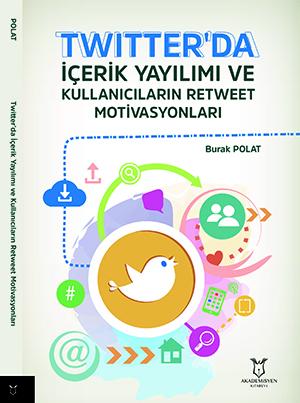
Twitter'da İçerik Yayılımı ve Kullanıcıların Retweet Motivasyonları
Özet
Bu kitap, Twitter'da içerik yayılımı ve kullanıcıların retweet motivasyonları üzerine bir araştırmayı ele almaktadır. Yeni medya olanaklarıyla birlikte mesaj üretimi, tüketimi ve dağıtımı önemli ölçüde değişmektedir. Sosyal medya, kitle iletişimi ile kişilerarası iletişimin iç içe geçtiği bir iletişim ortamı sunmaktadır. Twitter, kullanıcılarına mesajların hızlı bir şekilde yayılmasını sağlayan karmaşık bir yayılım süreci sunmaktadır. Bu platform, Türkiye'de popülerliği ve kamusal iletişim alanı olarak etkililiği göz önüne alındığında, yayılım fenomenini ve kullanıcıların aktarım kararındaki motivasyonlarını araştırmak önemlidir. Bu kitap, \"Sosyal Medyada İçeriğin Yayılımı ve Kullanıcıların Paylaşım Motivasyonları: Türkiye'de Twitter Kullanıcılarının Retweet Pratiği Üzerine Bir Araştırma\" başlıklı doktora tezinden üretilmiştir. Yazar, yayılım fenomenine ve kullanıcıların aktarım kararındaki motivasyonlara ışık tutmak amacıyla bu araştırmayı gerçekleştirmiştir. Kitap, sosyal medyanın gelişimi, kullanıcının ürettiği içerik, retweet kavramı ve Twitter'ın yayılım aracı olarak kullanımı gibi konuları ele almaktadır. Bu çalışma, iletişim bilimleri alanında yayılım konusunda araştırma yapmak isteyenlere rehberlik etmektedir.
This book examines a study on content dissemination on Twitter and users' motivations for retweeting. With the opportunities provided by new media, message production, consumption, and distribution have significantly changed. Social media offers a communication environment where mass communication and interpersonal communication are intertwined. Twitter provides a complex dissemination process that allows messages to spread quickly for its users. Considering its popularity and effectiveness as a public communication space in Turkey, it is important to investigate the dissemination phenomenon and users' motivations for sharing. This book is derived from a doctoral thesis titled \"Dissemination of Content and Users' Sharing Motivations in Social Media: A Study on Twitter Users' Retweet Practice in Turkey.\" The author conducted this research to shed light on the dissemination phenomenon and users' motivations for sharing. The book covers topics such as the development of social media, user-generated content, the concept of retweeting, and the use of Twitter as a dissemination tool. This study serves as a guide for those interested in conducting research on dissemination in the field of communication sciences.
Referanslar
Abramson, Jeffrey B., Arterton, F. Christopher ve Orren, Gary R. (1990). The Electronic Commonwealth: The Impact of New Media Technologies on Democratic Politics. Basic Books, New York, NY, A.B.D.
Adams, Paul (2012). Grouped: How Small Groups of Friends Are The Key to Influence on the Social Web. New Riders, Berkeley, CA, A.B.D.
Akarsu, Bedia (1998). Felsefe Terimleri Sözlüğü. İnkılâp Kitapevi, 11. Baskı. İstanbul, Türkiye.
Alter, Adam (2017). Irresistible: The Rise of Addictive Technology and the Business of Keeping Us Hooked. Penguin Press.
Altun, Fahrettin; Çağlar İsmail ve Yerlikaya, Turgay (2016). The Press Freedom in Turkey: Myths and Truths. Siyaset, Ekonomi ve Toplum Araştırmaları Vakfı. Erişim Tarihi: 03.07.2020 Erişim Adresi: https://setav.org/en/assets/uploads/2017/03/PressFreedom.pdf
Balcı, Ali (2010). Sosyal Bilimlerde Araştırma: Yöntem, Teknik ve İlkeler. Pegem Akademi, Gözden Geçirilmiş ve Genişletilmiş 8. Baskı.
Barabási, Albert-László (2002). Linked: The New Science of Networks. Perseus Books Group.
Barnes, Susan B. (2008). Understanding Social Media From The Media Ecological Perspective. Mediated Interpersonal Communication, s. 14-33, Editörler: Elly A. Konijn, Sonja Utz, Martin Tanis ve Susan B. Barnes, Routledge, New York, N.Y., A.B.D.
Barry, Thomas E. (1987). The Development of the Hierarchy of Effects: An Historical Perspective. Current Issues and Research in Advertising, 10:1-2, 251-295, DOI: 10.1080/01633392.1987.10504921
Başaran, Funda (2010). İletişim Teknolojileri ve Toplumsal Gelişme: Yayılmanın Ekonomi Politiği. Ütopya Yayınevi.
Bercovici, Jeff (2010). Who Coined ‘Social Media’? Web Pioneers Compete for Credit. Forbes.com. Erişim Tarihi: 30 Nisan 2016 http://www.forbes.com/sites/jeffbercovici/ 2010/12/09/who-coined-social-media-web-pioneers-compete-for-credit/#179242a51161
Berelson, Bernard (1949). What “Missing The Newspaper” Means. Communication Research 1948-1949, Editörler: Paul F. Lazarsfeld ve Frank N. Stanton, Harper and Brothers, s. 111-129 Erişim Tarihi: 10.06.2020 Erişim Adresi: https://simson.net/ref/1948/What_missing_the_newspaper_means.pdf
Berg, Bruce L. ve Lune Howard (2015). Görüşmeye Tiyatral Bakış. Sosyal Bilimlerde Nitel Araştırma Yöntemleri, Çeviri Editörü: Hasan Aydın, Çevirenler: İpek Som ve Gül Ekşi, Eğitim Yayınevi, 129-188.
Berger, Jonah ve Milkman, Kathrine L. (2012). What Makes Online Content Go Viral? Journal of Marketing Research, Cilt 49, Sayı 2, s. 192-205.
Berners-Lee, Tim, Hendler, James, Lassila Ora (2001). The Semantic Web: A new form of web content that is meaningful to computers will unleas a revolution of new possibilities. Scientific American. Erişim Tarihi: 01.05.2016 Adres: http://sciam.com/article.cfm?articleID=00048144-10D2-1C70-84A9809EC588EF21
Brecht, Bertolt (1932). Der Rundfunk als Kommunikationsapparat. In Blätter des Hessischen Landestheaters, No: 16, Darmstadt.
Boehmer Jan ve Tandoc Jr. (2015). Why We Retweet: Factors Influencing Intentions to Share Sport News on Twitter. International Journal of Sport Communication, Cilt 8, Sayı 2, s. 211-232.
Borders, Brett (2009). A brief history of social media. Erişim Tarihi: 12.05.2015 http://copybrighter.com/history-of-social-media
Bourse, M., & Yücel, H. (2012). İletişim Bilimlerinin Serüveni. Ayrıntı Yayınları. İstanbul, Türkiye
Boyd, Danah (2009). Social media is here to stay... Now what?. Microsoft Research Tech. Fest., Redmond, Washington 26 Şubat 2009. Erişim Tarihi: 08.05.2016 http://www.danah.org/papers/talks/MSRTechFest2009.html
Boyd, Danah; Golder, Scott ve Lotan, Gilad (2010). Tweet, Tweet, Retweet: Conversational Aspects of Retweeting on Twitter. HICSS-43, IEEE: Kauai, HI.
Blumler, Jay G. (1979). Role of Theory in Uses and Gratifications Studies. Communication Research, Cilt 5, Sayı 1, s. 9-36.
Breitrose, Henry (1986). The New Communication Technologies and the New Distrubution of Roles. The Media Revolution in America and in Western Europe, Editörler: Everett M. Rogers ve Francis Bale, Vol. 2, Ablex Publishing Corporation, s. 68 – 79, Norwood New Jersey, A.B.D.
Bruns, Axel ve Moe, Hallvard (2016). Twitter’da İletişim Yapısal Katmanları. Twitter ve Toplum, Derleyenler: Katrin Weller, Axel Bruns, Jean Burgess, Merja Mahrt ve Cornelius Puschmann Çevirmen: Emre Erbatur, Kafka Kitap, s. 62-78.
Bruns, A. & Moe, H. (2016). Twitter’da İletişimin Yapısal Katmanları. Schimidt, J. (2016). Twitter ve Kişisel Kamuların Doğuşu. Twitter ve Toplum. Çevirmen: Emre Erbatur. Epsilon Yayıncılık.
Burgelman, J. C. (1994). Assessing Information Technologies in the Information Society: The Relavence of Communication Science. Information Society and Civil Society: Contemporary Perspective on the Changing World Order, Slavco Splichal vd. (Ed.), Purdue University Press, A.B.D.
Byrne, David (1998). Complexity Theory and the Social Sciences: An Introduction. Routledge, New York, NY, ABD.
Castellani, Brian ve Hafferty, Frederic William (2009). Sociology and Complexity Science: A New Field of Inquiry. Springer, Berlin, Almanya. DOI 10.1007/978-3-540-884462-0
Castells, Manuel (2011). A Network Theory of Power. International Journal of Communication, Cilt 5, s.737-787.
Castells, Manuel (2013). Enformasyon Çağı: Ekonomi, Toplum ve Kültür. Ağ Toplumunun Yükselişi Cilt 1, İstanbul Bilgi Üniversitesi Yayınları, 3. Baskı, Çeviren: Ebru Kılıç, İstanbul, Türkiye.
CERN (2016). The Birth of the Web. 07.05.2016 Erişim Tarihi: http://home.cern/topics/birth-web
Cha, Meeyoung; Haddadi, Hamed; Benevenuto, Fabricio ve Gummadi, Krishna P. (2010). Measuring User Influence in Twitter: The Million Follower Fallacy. AAAI Publications, Fourth International AAAI Conference on Weblogs and Social Media. Erişim Tarihi: 19.05.2014 Erişim Adresi: https://www.aaai.org/ocs/index.php/ICWSM/ICWSM10/paper/view/1538/1826
Childe, Gordon (1944). Araçların Evrimi. Bilim ve Gelecek Dergisi, Sayı 144, Şubat 2016. Çeviren: Alaeddin Şenel
Choi, J. W.; Dekkers, A. C. M. ve Park, S. H. (2004). Motives of Internet Uses: Cross-cultural Perspectives - the US, the Netherlands, and South Korea, Erişim Tarihi: 02.07.2020 Erişim Adresi: https://surfsharekit.nl/publiek/fontys/3843a840-6345-4203-a5e6-faa52873d8ba
Clement, J. (2020a). Digital users worldwide 2020. Erişim Tarihi: 30 Haziran 2020. Erişim Adresi: https://www.statista.com/statistics/617136/digital-population-worldwide/
Clement, J (2020b). Leading countries based on number of Twitter users as of April 2020. Statista. Erişim Tarihi: 30 Haziran 2020. Erişim Adresi: https://www.statista.com/statistics/242606/number-of-active-twitter-users-in-selected-countries/
Complexity Academy (2016). Nonlinear Systems [Ders Notları]. Erişim Tarihi: 30 Nisan 2016 http://complexityacademy.io/course/nonlinear-systems/
Confessore, N., Dance, G. J., Harris, R., & Hansen, M. (2018). The Follower Factory. The New York Times. Erişim Adresi: https://www.nytimes.com/interactive/2018/01/27/technology/social-media-bots.html Erişim Tarihi: 20.07.2020
Constine, Josh (2016). Facebook Climbs To 1.59 Billion Users and Crushes Q4 Estimates With $5.8B Revenue. Tech Crunch. Erişim Tarihi: 13.05.2016 http://techcrunch.com/2016/01/27/facebook-earnings-q4-2015/
Coursaris, Constantinos K.; Yun, Younghwa ve Sung, Jieun (2010). Understanding Twitter’s adoption and use continuance: the Synergy between Uses and Gratifications and Diffusion of Innovations. SIGHCI 2010 Proceedings. Sayı 3.
Erişim Tarihi: 02.02.2020 Erişim Adresi: https://aisel.aisnet.org/sighci2010/3
Creswell, John W. (2014). Research Design: Qualitative, Quantitative, and Mixed Method Approaches. Sage Publications, 4. Baskı.
Creswell John W. & Clark, Vicki L.P. (2018). Designing and Conducting Mixed Methods Research. SAGE, 3. Baskı.
Dafonte-Gómez, Alberto (2018). Audience as Medium: Motivations and Emotions in News Sharing. International Journal of Communication, Sayı 12, s. 2133-2152.
Dance, Frank E. X. (1970). The “Concept” of Communication. Journal of Communication, 20. Sayı, s. 201- 210.
Dawkins, Richard (2006). The Selfish Gene. Oxford University Press, 30. Yıl Baskısı.
Demirbaş, Yavuz (2017). Oyun Çalışmalarında Dijital Anlatı ile Oyun Biçimi Karşıtlığı Ekseninde Süren Tartışmalara Farklı Bir Bakış. Moment Dergi, v. 4, n. 2, Erişim Adresi: http://www.momentdergi.org/index.php/momentdergi/article/view/273/502 Erişim Tarihi: 03.01.2020
Dilmen, N. Emel ve Öğüt, Sertaç (2010). Yeni İletişim Ortamları ve Etkileşim’e Bilişim Yaklaşımı. Yeni İletişim Ortamları ve Etkileşim Uluslararası Konferansı. İstanbul, Türkiye.
Dilmen, N. Emel (2007). Yeni Medya Kavramı Çerçevesinde İnternet Günlükleri-Bloglar ve Gazeteciliğe Yansımaları. Marmara İletişim Dergisi, Sayı: 12 Cilt: 1, s. 113-122, İstanbul, Türkiye.
Dearing, J.W. (2008). Evolution of Diffusion and Dissemination Theory. J Public Health Management Practice, 14(2): s. 99-108.
Dilmen, N. Emel & Öğüt, Sertaç (2010). Sosyalleşmenin Yeni Yüzü: Sosyal Paylaşım Ağları. İkinci Yeni İletişim Ortamları ve Etkileşim Uluslararası Konferansı. İstanbul, Türkiye
Domosh, Mona; Neumann, Roderick P.; Price, Patricia L. ve Jordan-Bychkov, Terry G. (2010). Human Mosaic: A Cultural Approach to Human Geography. W.H. Freeman & Company, 11. Baskı, New York, N.Y., A.B.D..
Dorsey, J. (2006a). twttr sketch. Flickr. Yayınlanma Tarihi: 24.03.2006. Erişim Tarihi:16.07.2016. Erişim Adresi: https://www.flickr.com/photos/jackdorsey/182613360/
Dorsey, J. (2006b). first twttr. Flickr. Yayınlanma Tarihi: 5.07.2006. Erişim Tarihi: 16.07.2016. Erişim Adresi: https://www.flickr.com/photos/jackdorsey/182614595/
Dredge, S. (2014). Twitter changes: 20 hits and misses from the social network’s history. The Guardian. Yayınlanma Tarihi: 22.11.2014 Erişim Tarihi: 24.07.2016 Erişim Adresi:
https://www.theguardian.com/technology/2014/oct/22/twitter-changes-hits-misses-history
Durkheim, Emile (2005). Suicide. Routledge Classics, Çeviren: John A. Spaulding ve George Simpson, Londra, Birleşik Krallık.
Edelman (2019). 2019 Edelman Trust Barometer Global Report. Erişim Tarihi: 03.07.2020 Erişim Adresi: https://www.edelman.com/sites/g/files/aatuss191/files/2019-02/2019_Edelman_Trust_Barometer_Global_Report.pdf
Erdoğan, İrfan (2010). Kitle İletişimi: Ekonomik ve Siyasal Pazar İçin Bilinç Yönetimi. Erişim Tarihi: 15.05.2016 Erişim Adresi: http://www.irfanerdogan.com/intro2com/massmedia.html
Erdoğan, İrfan ve Alemdar, Korkmaz (2010). Öteki Kuram. Erk Yayınları, 3. Baskı, Ankara, Türkiye.
Erdoğan, İrfan (2011). İletişimi Anlamak. Erk Yayınları, 4. Baskı. Ankara, Türkiye
Etymonline (2020a). Diffusion. Erişim Tarihi: 05.06.2020 Erişim Adresi: http://www.etymonline.com/index.php?term=diffusion
Etymonline (2020b). Innovation. Erişim Tarihi: 05.06.2020 Erişim Adresi: http://www.etymonline.com/index.php?term=innovation
Etymonline (2020c). Innovation. Erişim Tarihi: 05.06.2020 Erişim Adresi: http://www.etymonline.com/index.php?term=viral
Firdaus, Nadia Syeda; Ding, Chen ve Sadeghian, Alireza (2018). Retweet: A popular information diffusion mechanism – A survey paper. Online Social Networks and New Media, Sayı 6, s. 26 40.
First Versions (2015). Twitter. Yayınlanma Tarihi: Temmuz 2015. Erişim Tarihi: 16.07.2016. Erişim Adresi: https://www.firstversions.com/2015/07/twitter.html
Fiske, John (2014). İletişim Çalışmalarına Giriş. Pharmakon Yayınevi, Üçüncü Basım, Çevirmen: Süleyman İrvan.
Freedom House (2020). Turkey. Erişim Tarihi: 03.07.2020 Erişim Adresi: https://freedomhouse.org/country/turkey/freedom-world/2020
Fuchs, Christian; Hofkirchner, Wolfgang; Schafranek, Matthias; Raffl, Celina; Sandoval, Marisol ve Bichler, Robert (2010). Theoretical Foundations of the Web: Cognition, Communication, and Co-Operation. Towards an Understanding of Web 1.0, 2.0, 3.0.. Future Internet 2010, 2, s. 41-59; doi:10.3390/fi2010041.
Fuchs, Christian (2012). Capitalism or Information Society? The Fundamental Question of the Present Structure of Society. European Journal of Social Theory. DOI: 10.1177/136843102461432.
Fuchs, Christian (2014). Critique of the Political Economy of Informational Capitalism and Social Media. Critique, Social Media and the Information Society, Editörler: Christian Fuchs ve Marisol Sandoval, Routledge, New York, A.B.D.
Fuchs, Christian (2014). Social Media A Critical Introduction. Steele, Mila (ed.) Sage Publications ISBN 978-1-4462-5730-2.
Gaiman, Neil (2009). Erişim Adresi: https://twitter.com/neilhimself/status/1178514410 Erişim Tarihi: 3.3.2021
Gan, Chunmei ve Wang, Weijun (2014). Weibo or Weixin? Gratifications for Using Different Social Media. 13th Conference on e-Business, e-Services and e-Society (I3E), s.14-22.
Gazzeley, Adam ve Rosen, Larry D. (2019). Dağınık Zihin: Yüksek Teknoloji Dünyasında Kadim Beyinler. Metis Yayıncılık. Çeviri: Aysun Babacan.
Geray, H. (2003). İletişim ve Teknoloji: Uluslararası Birikim Düzeninde Yeni Medya Politikaları. Ütopya Yayınevi, Ankara, Türkiye.
Geray, H. (2005). İletişim Ağları ve Masaüstü Sömürgecilik. İletişim Ağlarının Ekonomisi: Telekomünikasyon, Kitle İletişimi, Yazılım ve İnternet, Derleyenler: Funda Başaran ve Haluk Geray, Siyasal Kitapevi, Ankara, Türkiye.
Geray, H. (2011). Toplumsal Araştırmalarda Nicel ve Nitel Yöntemlere Giriş. Genesis Kitap, Gözden Geçirilmiş ve Genişletilmiş 3. Baskı.
Gerbner, George (2005). Kitle İletişim Araçları ve İletişim Kuramı. Kitle İletişim Kuramları, Derleyen: Erol Mutlu, s. 75 -100, Ütopya Yayınevi, Ankara, Türkiye.
Given, L. M. (2008). The sage encyclopedia of qualitative research methods. Thousand Oaks, CA Sage.
Goffman, Erving (2018). Günlük Yaşamda Benliğin Sunumu. Metis Yayınları, İkinci Basım, Çevirmen: Barış Cezar.
Gorton, David (2020). The Seven Companies Owned By Twitter. Investopedia. Erişim Tarihi: 23.05.2020 Erişim Adresi: https://www.investopedia.com/articles/insights/082216/top-8-companies-owned-twitter-twtr.asp
Goldstein, Michael; King Gail ve Wright, Meghan (2009). Diffusionism and Acculturation. Antropological Theories, The University of Alabama Department of Anthropology Erişim Tarihi: 05.06.2016 http://anthropology.ua.edu/cultures/cultures.php?culture=Diffusionism%20and%20Acculturation
Gorton, David (2020). The Seven Companies Owned By Twitter. Investopedia. Erişim Tarihi: 23.05.2020 Erişim Adresi: https://www.investopedia.com/articles/insights/082216/top-8-companies-owned-twitter-twtr.asp
Guha, Ramanathan V. (2013). Light at the End of the Tunnel. International Semantic Web Conference 2013, Keynote. Erişim Tarihi: 7 Mayıs 2016. http://iswc2013.semanticweb.org/content/keynote-ramanathan-v-guha.html
Guliciuc, Viorel (2014). Complexity and Social Media. LUMEN 2014. Procedia –Social and Behavioral Sciences 149. S. 371-375.
Halavais, A. (2016). Twitter’ın Yapısı: Toplumsal ve Teknik. Schimidt, J. (2016). Twitter ve Kişisel Kamuların Doğuşu. Twitter ve Toplum. Çevirmen: Emre Erbatur. Epsilon Yayıncılık.
Haridakis, P., & Hanson, G. (2009). Social Interaction and Co-Viewing with YouTube: Blending Mass Communication Reception and Social Connection. Journal of Broadcasting & Electronic Media, Sayı 53, s. 317-335. http://dx.doi.org/10.1080/08838150902908270
Hartley, Peter (2014). Kişilerarası İletişim. İmge Kitapevi, Çevirenler: Ülkü Doğanay, Melike Aktaş Yamanoğlu, Burcu Şimşek, Pınar Özdemir, Halise Karaaslan Şanlı ve İnan Özdemir Taştan, 2. Baskı, Ankara, Türkiye.
Hawking, Stephen ve Mlodinow, Leonard (2010). Büyük Tasarım. Doğan Kitap, Çeviren: Selma Öğünç, İstanbul, Türkiye.
Hermida, Alfred (2016) Sanal Ortam Haber Ağı Olarak Twitter. Twitter ve Toplum, Derleyenler: Katrin Weller, Axel Bruns, Jean Burgess, Merja Mahrt, Cornelius Puschmann, Çevirmen: Emre Erbatur, Kafka Kitap, s. 466-483.
Hofkirchner, Wolfgang (2013). Emergent information: An unified theory of information framework. Singapore: World Scientific.
Hülür, Himmet ve Yaşın, Cem (2019). Küresel İnsanın Hayal Alanı Olarak Twitter’ı Anlamak. Bilgi, Doğruluk ve Twitter, Editörler: Himmet Hülür ve Cem Yaşın, Ütopya Yayınevi, Ankara.
Java, A., Song, X., Finin T. & Tseng, B. (2007). Why We Twitter: Understanding Microblogging Usage and Communities. Joint 9th WEBKDD and 1st SNA KDD Workshop. San Jose, CA, USA. Erişim Tarihi: 03.08.2016 Erişim Adresi: https://ebiquity.umbc.edu/_file_directory_/papers/369.pdf
Jenkins, Henry (2006). Convergence Culture: Where Old and New Media Collide. New York University Press.
Jensen, J. F. (1998). Interactivity: Tracing a new concept in media and communication studies. Nordicom Review, 19, s. 185-204.
Kaplan, Andreas M. ve Haenlein, Michael (2010). Users of the World, Unite! The Challanges and Opportunities of Social Media. Business Horizons 53, s 59 – 68.
Kara, Tolga (2013). Sosyal Medya Endüstrisi. Beta Yayınclık, İstanbul, Türkiye.
Kaye, Barbara K. ve Johnson, Thomas J. (2002). Online and in the Know: Uses and Gratifications of the Web for Political Information, Journal of Broadcasting and Electronic Media, Cilt 46, Sayı 1, s. 54-71, DOI: 10.1207/s15506878jobem4601_4
Korgaonkar, Pradeep K., ve Wolin, Lori D (1999). A Multivariate Analysis of Web Usage. Journal of Advertising Research, Cilt 39, Sayı 2.
Karvalics, Laszlo Z. (2007). Information Society – What Is It Exactly? The Meaning, History And Conceptual Framework Of An Expression. Network for Teaching Information Society, Budapeşte, Macaristan.
Katz, E. (1959). Mass Communications Research and the Study of Popular Culture: An Editorial Note on a Possible Future for This Journal. Studies in Public Communication, Sayı 2, s. 1-6. Erişim Tarihi: 03.02.2018 Erişim Adresi: http://repository.upenn.edu/asc_papers/165
Katz, Elihu; Gurevitch, Michael ve Haas, Hadassah (1973). On the Use of the Mass Media for Important Things. American Sociological Review, 38 (2), s. 164-181. Erişim Tarihi: 31.03.2019 Erişim Adresi: http://repository.upenn.edu/asc_papers/267
Katz, Elihu; Blumler, Jay G. Ve Gurevitch, Michael (1974). Uses and Gratification Research. The Public Opinion Quarterly, Cilt 37, Sayı 4; s. 509-523. Erişim Tarihi: 01.10.2013 Erişim Adresi: http://www.jstor.org/stable/2747854
Katz, Elihu (2006). Rediscovering Gabriel Tarde. Political Communication, 23 (3), s. 263-270.
Katz, Elihu ve Lazarsfeld, Paul F. (1955). Personal Influence: The Part Played by People in the Flow of Mass Communications. Free Press, New York, N.Y., A.B.D..
Kertesz, Janos (2015). Fundamental Ideas of Network Science. [Ağ Bilimi Ders Notları]. Central European University Ağ Bilimi Merkezi, Budapeşte, Macaristan.
Kietzmann, Jan H.,; Hermkens, Kristopher; McCarthy, Ian P. Ve Silvestre, Bruno S. (2011). Social Media? Get serious! Understanding the Functional Blocks of Social Media. Business Horizons,Vol. 54-3. s. 241-251.
Kim, W; Jeong. O. & Lee, S. (2010). On Social Web Sites. Information Systems, vol. 35-2, s. 215 – 236.
Kincaid, Lawrence D. (1979). The Convergence Model of Communication. Papers of the East-West Communication Institute No. 18. Honolulu, Hawaii, A.B.D.
Kulovitz, Kimberly L. (2017). Blog and Research. The Sage Encyclopedia of Communication Research Methods, Editör: Mike Allen, Sage Publications, s. 100-101.
Kwak, Haewoon; Lee, Changhyun; Park, Hosung ve Moon Sue (2010). What is Twitter, a Social Network or a News Media?. WWW2010. Erişim Tarihi: 02.01.2014 Erişim Adresi: http://www.ambuehler.ethz.ch/CDstore/www2010/www/p591.pdf
Latour, Bruno (2011). The Debate. Erişim Tarihi: 06.06.2016 http://www.bruno-latour.fr/sites/default/files/downloads/TARDE-DURKHEIM-GB.pdf
Lasorsa, Dominic L.; Lewis, Seth C. Ve Holton, Avery E. (2012). Normalizing Twitter: Journalism Practice in an Emerging Communication Space. Journalism Studies, Cilt 13, Sayı 1, s. 19-36.
Lin, T., Wu, H.; Liao, C., Liu T., (2006). Why are some e-mails forwarded and others not?. Internet Research, Vol. 16 Iss 1 pp. 81 - 93
Lister, Martin; Dovey, Jon; Giddins, Seth; Grant, Iain ve Kelly, Kieran (2003). New Media: A Critical Introduction. Routledge, New York, N.Y., A.B.D.
Littlejohn, Stephen W. Ve Foss, Karen A. (2008). Theories of Human Communication. Thomson Wadsworth, 9. Baskı, California, A.B.D.
Littlejohn, Stephen W. Ve Foss, Karen A. (2009). Encyclopedia of Communication Theory. SAGE, California, A.B.D.
Liu, Ivy L.B.; Cheung, Christy M.K.; and Lee, Matthew K.O. (2010) Understanding Twitter Usage: What Drive People Continue to Tweet. PACIS 2010 Proceedings. Erişim Tarihi: 16.03.2016 Erişim Adresi: http://aisel.aisnet.org/pacis2010/92
Ma, L., Lee, C. S., Goh, D. H.-L. (2014). Understanding news sharing in social media. An explanation from the diffusion of innovations theory. Online Information Review, Sayı 38, s. 598–615.
Mahmoud, Abd El- Basit ve Auter, Philip J. (2009). The Interactive Nature of Computer-Mediated Communication. American Communication Journal, Vol. 11, No. 4
Majmundar, A., Allem, J., Cruz, T. B., & Unger, J. B. (2018). The Why We Retweet scale. Plos One, 13(10). doi:10.1371/journal.pone.0206076
Manovich, Lev (2001). The Language of New Media. MIT Press. Massachusetts, A.B.D.
Martinez, Lourdes S.; Spitzberg, Brian; Tsou, Ming-Hsiang; Issa, Elias ve Peddecord, Michael (2017). Vax Populi: The Social [Media] (De)Construction of Public Health Policy. International Communication Association Conference, San Diego, CA, A.B.D.
Maslow, Abraham H. (1954). Motivation and Personality. Harper and Row Publishers.
Masuda, Yoneji (1980). The Information Society as Post-Industrial Society. The World Future Society, Tokyo, Japonya.
Masuda, Yoneji (1985). Computopia. The Microelectronics Revolution, Editör: T. Forester, Oxford: Basil Blackwell, Birleşik Krallık, s. 620-634.
Mayer, Paul (1999). Computer Media and Communication: a Reader. Oxford University Press, Londra, İngiltere.
McLuhan, Marshall (2005). The medium is the message. Corte Madera: Gingko Press.
McQuail, Denis (2010). McQuail’s Mass Communication Theory. SAGE, 6. Baskı, Londra, Birleşik Krallık.
McQuail, Denis ve Windahl, Sven (2010). İletişim Modelleri -Kitle İletişimi Çalışmalarında- . İmge Kitapevi, 3. Baskı, Çeviren: Konca Yumlu, Ankara, Türkiye.
MFGLabs (2017). Oscar Selfie Report. Erişim Tarihi: 15.12.2018 Erişim Adresi: http://mfglabs.s3.amazonaws.com/public/ellen-selfie-reach/index.html
Mitchell, Amy; Simmons, Katie; Matsa, Katerina Eva ve Silver, Laura (2018). Public Globally Wants Unbiased News Coverage, But Are Divided On Whether Their News Media Deliver. Pew Research Center. Erişim Tarihi: 03.07.2020 Erişim Adresi: https://www.pewresearch.org/global/wp-content/uploads/sites/2/2018/01/Publics-Globally-Want-Unbiased-News-Coverage-but-Are-Divided-on-Whether-Their-News-Media-Deliver_Full-Report-and-Topline-UPDATED.pdf
Mitchell, Melanie (2011). Complexity: A Guided Tour. Oxford University Press, New York, New York, A.B.D.
Morozov, Evgeny (2009). Iran: Downside to the “Twitter Revolution”. Dissent, Cilt 56, Sayı 4, s. 10-14.
Morozov, Evgeny (2019). Twitter’dan Sonra Bir Tarih Kaldı Mı? Sanal Ağ Yanılsaması. Açılım Kitap, I. Baskı, Çeviren: Murat Tekin.
Murthy, Dhiraj (2013). Twitter, Social Communication in The Twitter Age. Polity Press.
Nezlek, J., & Dersk, P. (2006). Use of humor as a coping mechanism, psychological adjustment, and social interaction. Humor, 14 (4). De Gruyter, 395-413.
NDMU (2018). History of Blogging. Notre Dame of Maryland University. Erişim Tarihi: 21.02.2021 Erişim Adresi: https://online.ndm.edu/news/communication/history-of-blogging/
O’Reilly, Tim (2005). What is Web 2.0: Design Patterns and Business Models for the Next Generation of Software. O’Reily Media. Erişim Tarihi: 07.05.2016 http://www.oreilly.com/pub/a/web2/archive/what-is-web-20.html
O’Reily, Tim ve Battelle, John (2009). Web Squared: Web 2.0 Five Years On. Web2.0Summit Konferansı Erişim Tarihi: 07.05.2016 http://www.web2summit.com/web2009/public/schedule/detail/10194
Oxford Dictionaries. Diffusion. Erişim Tarihi: 05.06.2016 http://www.oxforddictionaries.com/definition/english/diffusion
Özçetin, Burak (2010). “Kullanımlar Doyumlardan” İzlerkitle Sosyolojisine: Türkiye’de İzlerkitle Çalışmaları. İletişim: Araştırmaları, Cilt 8, Sayı 2, s.9 – 46.
Özçetin, Burak (2018). Kitle İletişim Kuramları: Kavramlar, Okullar, Modeller. İletişim Yayınları, 1. Baskı.
Özer, Ömer (2016). Doyumun Öyküsü: Twitter Örneğinde Kullanımlar ve Doyumlar Kuramı Çerçevesinde Yapılan Araştırmalar. Literatürk Academia.
Papacharissi, Zizi ve Rubin, Alan M. (2000). Predictors of Internet Use. Journal of Broadcasting & Electronic Media, Cilt 44, Sayı 2, s.175-196, DOI: 10.1207/s15506878jobem4402_2
Passant, A., Hastrup, T., Bojars, U. & Breslin John (2008). Microblogging: A Semantic and Distributed Approach. 4th Workshop on Scripting fort the Semantic Web (SFSW 2008). Erişim Tarihi: 04.04.2017 Erişim Adresi: http://www.johnbreslin.com/files/publications/20080602_sfsw2008a.pdf
Peker, Aslı (2016). Troller, botlar, astroturf: Sosyal medyanın anti-sosyal yüzüyle baş etme rehberi. Birikim, Sayı 322. Erişim Tarihi: 04.03.2019 Erişim Adresi: https://www.birikimdergisi.com/dergiler/birikim/1/sayi-322-subat-2016/7489/troller-botlar-astroturf-sosyal-medyanin-anti-sosyal-yuzuyle-bas-etme-rehberi/7501
Polat, Burak (2015). Social Media’s Position in Web Within the Scope of Online Information Flow. European Journal of Social Science Education and Research, Cilt 3, Sayı 3, s. 48-56.
Polkosky, Melanie D. (2008). Machines as Mediators: The Challange of Technology for Interpersonal Communication Theory and Research. Mediated Interpersonal Communication, s. 34-57, Editörler: Elly A. Konijn, Sonja Utz, Martin Tanis ve Susan B. Barnes, Routledge, New York, N.Y., A.B.D.
Prochaska, James O.; Norcross, John C.; DiClemente, Carlo C. (1994). Changing for good: The Revolutionary Program That Explains The Six Stages Of Change And Teaches You How To Free Yourself From Bad Habits. William Morrow and Company, Inc. Erişim Tarihi: 25.06.2020 Erişim Adresi: https://archive.org/details/changingforgoodr00proc/page/n7/mode/2up
Rafaeli, S. (1986). The Electronic Bulletin Board: A Computer-Driven Mass Medium. Computers and the Social Sciences, Cilt 2, Sayı 2, s. 123-136.
Rafaeli, S. (1988). Interactivity: From New Media to Communication. Advancing communication science: merging mass and interpersonal processes Editörler: R.P. Hawkins, J.M. Wieman, ve S. Pingree Sage, s. 110-134, Newbury, CA, A.B.D.
Reiff, Nathan (2020). How Twitter Makes Money. Investopedia. Erişim Tarihi: 23.05.2020 Erişim Adresi: https://www.investopedia.com/ask/answers/120114/how-does-twitter-twtr-make-money.asp
Reuters Gazetecilik Çalışma Enstitüsü (2020). Reuters Institute Digital News Report 2020. Reuters Institute, Oxford University. Erişim Tarihi: 03.07.2020 Erişim Adresi: https://reutersinstitute.politics.ox.ac.uk/sites/default/files/2020-06/DNR_2020_FINAL.pdf
Rogers, Everett M. ve Kincaid, D. Lawrence (1981). Communication Networks: Toward a New Paradigm for Research. Free Press, New York, N.Y., A.B.D..
Rogers, Everett M. (1986). Communications Technology: The New Media in the Society, Free Press, New York, N.Y., A.B.D.
Rogers, Everett M. (2003). Diffusion of Innovation. Free Press, 5. Baskı. New York, N.Y., A.B.D.
Rogers, Richard (2016). Twitter’ı Sıradanlıktan Kurtarmak: Bir Çalışma Nesnesinin Dönüşümü. Twitter ve Toplum. Çevirmen: Emre Erbatur. Epsilon Yayıncılık.
Rosen, Aliza (2017). Tweeting Made Easier. Twitter Kurumsal Blog. Erişim Tarihi: 13.06.2020 Erişim Adresi: https://blog.twitter.com/en_us/topics/product/2017/tweetingmadeeasier.html
Rosenstiel, Tom; Sonderman, Jeff; Loker, Kevin; Ivancin Maria ve Kjarval, Nina (2015). Twitter and the News: How people use the social network to learn about the World. American Press Institute. Erişim Tarihi: 03.07.2020 Erişim Adresi: https://www.americanpressinstitute.org/publications/reports/survey-research/how-people-use-twitter-news/
Ruggiero, Thomas E. (2000). Uses and Gratifications Theory in the 21st Century. Mass Communication & Society, Cilt 3, Sayı 1, s. 3-37.
Saka, Erkan (2016). Siyasi Trollük Örneği Olarak Ak Troller. Birikim, Sayı 322. Erişim Tarihi: 03.04.2020 Erişim Adresi: https://www.academia.edu/21618767/Siyasi_Troll%C3%BCk_%C3%B6rne%C4%9Fi_olarak_AkTroller
Sarno, D (2009). Twitter creator Jack Dorsey illuminates the site’s founding document. Part I. Los Angeles Times. Yayınlanma Tarihi: 19.02.2009 Erişim Tarihi: 16.07.2016 Erişim Adresi: https://latimesblogs.latimes.com/technology/2009/02/twitter-creator.html
Scott, Peter R. ve Jacka, J. Mike (2011). Auditing Social Media: A Governance and Risk Guide. Joh Wiley & Sons, Inc. New Jersey, A.B.D.
Schmidt, J. (2016). Twitter ve Kişisel Kamuların Doğuşu. Twitter ve Toplum. Çevirmen: Emre Erbatur. Epsilon Yayıncılık.
Schultz, K.V. (1958). The psychologically healthy person: A study in identification and prediction. Journal of Clinical Psychology, Sayı 14, s. 112-117. doi:10.1002/1097-4679(195804)14:2<112::AID-JCLP2270140203>3.0.CO;2-3
Shahbaz, Adrian ve Funk, Allie (2019). The Crisis of Social Media. Freedom on the Net 2019, Freedom House. Erişim Tarihi: 03.07.2020 Erişim Adresi: https://freedomhouse.org/sites/default/files/2019-11/11042019_Report_FH_FOTN_2019_final_Public_Download.pdf
Sharag-Elding, Adiyana; Ye, Xinyue ve Spitzberg, Brian (2018). Multilevel model of meme diffusion of fracking through Twitter. Chinese Sociological Dialogue, Cilt 3, Sayı 1, s. 17-43.
Shifman, Limor (2011). An Anatomy of a Youtube Meme. New Media and Society, Cilt 14, Sayı 2 s. 187-203.
Shifman, Limor (2013). Memes in a Digital World: Reconciling with a Conceptual Troublemaker, Journal of Computer-Mediated Communication, Cilt 18, Sayı 3, s. 362-377.
Shifman, Limor (2014). Memes in Digital Culture. MIT Press.
Stanford İnternet Gözlemevi (2020). Analysis of June 2020 Twitter takedowns linked to China, Russia and Turkey. Stanford Internet Observatory Cyber Policy Center Blog. Erişim Tarihi: 03.07.2020 Erişim Adresi: https://cyber.fsi.stanford.edu/io/news/june-2020-twitter-takedown
Steinfatt, Thomas M. (2009). Definition of Communication. Encyclopedia of Communication Theory. Editörler: Stephen W. Littlejohn ve Karen A. Foss, SAGE, California, A.B.D.
Shannon, Claude E. (1948). A Mathematical Theory of Communication. The Bell System Technical Journal, Sayı 27.
Shannon, Claude E. Ve Weaver, Warren (1949). The Matematical Theory of Communication. University of Illinois Press, Chicago, A.B.D.
Sınır Tanımayan Gazeteciler (2020). Türkiye. Erişim Tarihi: 03.07.2020 Erişim Adresi: https://rsf.org/en/taxonomy/term/145
Song, I., LaRose, R., Eastin, M. S., & Lin, C. A. (2004). Internet gratifications and Internet addiction: On the uses and abuses of new media. Cyberpsychology, Behavior, and Social Networking, Sayı 7, s. 384-394. https://doi.org/10.1089/cpb.2004.7.384
Spitzberg, Brian (2014). Toward a Model of Meme Diffusion (M3D). Communication Theory, Cilt 24, Sayı 3, s. 311-339.
Sundar, S. Shyam (2008). Self as Source: Agency and Customization in Interactive Media. Mediated Interpersonal Communication, s. 58-74, Editörler: Elly A. Konijn, Sonja Utz, Martin Tanis ve Susan B. Barnes, Routledge, New York, N.Y., A.B.D.
Şener, Serkan (2018). Mizahın dili ve uyuşmazlık. Bilim ve Gelecek, 168. Sayı, 35-43.
Takahashi, Toshi (2010). Audience Studies: A Japanese Perspective. Routledge Taylor & Francis Group,
Tankovska, H (2021). Leading countries based on the number of Twitter users as of January 2021. Statista. Erişim Tarihi: 03.03.2021 Erişim Tarihi: https://www.statista.com/statistics/242606/number-of-active-twitter-users-in-selected-countries/
Tarde, Gabriel (1903). Laws of Imitation. Henry Holt & Company, Çeviri: Elsie Clews Parsons, New York, N.Y., A.B.D..
TED (2019). How Twitter Needs To Change?. Erişim Tarihi: 02.06.2020 Erişim Adresi: https://www.ted.com/talks/jack_dorsey_how_twitter_needs_to_change
Tekin, H. (2012). Nitel Araştırma Yönteminin Bir Veri Toplama Tekniği Olarak Derinlemesine Görüşme. İstanbul University Journal of Sociology, 3 (13) , 101-116. Erişim Adresi: https://dergipark.org.tr/tr/pub/iusosyoloji/issue/521/4777 Erişim Tarihi: 13.04.2021
Törenli, Nurcan (2005). Bilişim Teknolojileri Temelinde Haber Medyasının Biçimlenişi: Yeni Medya, Yeni İletişim Ortamı. Bilim ve Sanat Yayınları, Ankara, Türkiye, s. 87 - 164.
The New York Times Customer Insight Group (2011). The Psychology of Sharing: Why Do People Share Online?. Erişim Tarihi: 06.03.2020 Erişim Adresi: https://www.bostonwebdesigners.net/wp-content/uploads/POS_PUBLIC0819-1.pdf
Thompson, John B. (2005). Kitle İletişiminin Bazı Özellikleri. Kitle İletişim Kuramları, Derleyen: Erol Mutlu, s. 210-220, Ütopya Yayınevi, Ankara, Türkiye.
Thompson, Nik; Wang, Xuequn ve Daya, Pratiq (2019). Determinants of News Sharing Behavior on Social Media. Journal of Computer Information Systems, DOI: 10.1080/08874417.2019.1566803
Truong, Steven (2011). Jack Dorsey on the History of Twitter and Square. The Unofficial Stanford Blog. Yayınlanma Tarihi: Mayıs 2011. Erişim Tarihi: 19.07.2016. Erişim Adresi: https://tusb.stanford.edu/2011/05/jack-dorsey-on-the-history-of-twitter-and-square.html
Tüfekçi, Zeynep (2017a). Twitter and Tear Gas: The Power and Fragility of Networked Protest. Yale University Press.
Tüfekçi, Zeynep (2017b). Twitter and Tear Gas: How Social Media Changed Protest Forever. Wired. Erişim Tarihi: 14.02.2020 Erişim Adresi: https://www.wired.com/2017/05/twitter-tear-gas-protest-age-social-media/
Türk Dil Kurumu Büyük Türkçe Sözlük (2020a). Yayılım. Erişim Tarihi: 05.06.2020 Erişim Adresi: https://sozluk.gov.tr/?kelime=yayilim
Türk Dil Kurumu Büyük Türkçe Sözlük (2020b). İnovasyon. Erişim Tarihi: 05.06.2020 Erişim Adresi: https://sozluk.gov.tr/?kelime=inovasyon
Türik Bitig (2016). Yaγїl. Erişim Tarihi: 05.06.2016 Erişim Adresi: http://bitig.org/index.php?l=J&wi=833&lang=e&mod=3
Tvhistorypod.com (2015). Episode 17 – Interactive TV, Part 1. Erişim Tarihi: 12 Mayıs 2016 http://www.tvhistorypod.com/?m=201508
Twitter Safety (2020). Disclosing networks of state-linked information operations we’ve removed. Twitter Kurumsal Blog. Erişim Tarihi: 03.07.2020 Erişim Adresi: https://blog.twitter.com/en_us/topics/company/2020/information-operations-june-2020.html
Twitter (2020). Twitter Şeffaflık Raporu. Erişim Tarihi: 03.07.2020 Erişim Adresi: https://transparency.twitter.com/
Uma, Sekaran (2002). Research Methods for Business: A Skill Building Approach. Wiley, 4. Edition.
Valente, Thomas W. (1995). Network Models of the Diffusion of Innovations. Hampton Press.
Van Dijck, Jose (2013). The Culture of Connectivity: A Critical History of Social Media. Oxford University Press.
W3C (2009). W3C Semantic Web FAQ. Erişim Tarihi: 7 Mayıs 2016. https://www.w3.org/RDF/FAQ
Weller, K., Bruns, A., Burgess, J., Mahrt, M. & Puschmann, C. (2016). Twitter ve Toplum: Giriş. Twitter ve Toplum. Çevirmen: Emre Erbatur. Epsilon Yayıncılık.
Weng, L., Flammini, A., Vespignani, A. ve Menczer F. (2012). Competition Among Memes in a World With Limited Attention. Nature. Erişim Tarihi: 02.08.2014 Erişim Adresi: https://www.nature.com/articles/srep00335
Weng, L. (2014). Information Diffusion on Online Social Networks. Doktora Tezi. Erişim Tarihi: 02.08.2014 Erişim Adresi: https://lilianweng.github.io/papers/weng-thesis-single.pdf
World Bank (2014). Internet Users Data. Erişim Tarihi: 08.05.2016 http://data.worldbank.org/indicator/IT.NET.USER.P2/countries?display=graph
World Wide Web Foundation (2012). History of the Web. Erişim Tarihi: 7 Mayıs 2016 http://webfoundation.org/about/vision/history-of-the-web/
Xie, Suzanne (2020). Testing, testing… new conversation settings. Twitter Kurumsal Blog. Erişim Tarihi: 05.06.2020 Erişim Adresi: https://blog.twitter.com/en_us/topics/product/2020/testing-new-conversation-settings.html
Yang, Q., Tufts, C., Ungar, L., Guntuku, S., & Merchant, R. (2018). To Retweet or Not to Retweet: Understanding What Features of Cardiovascular Tweets Influence Their Retransmission. Journal of Health Communication, Cilt 23, Sayı 12, s. 1026-1035. doi:10.1080/10810730.2018.1540671
Yoo, Chan Yun (2011). Modeling Audience Interactivity as the Gratification-Seeking Process in Online Newspapaers. Communication Theory, Cilt 21, Sayı 1, s. 67-89.
Zedeck, Sheldon (2014). APA Dictionary of Statistics and Research Methods. American Psychological Association. Erişim Adresi: https://www.jstor.org/stable/j.ctv1chs825 Erişim Tarihi: 23.05.2021
Zuckerberg, Mark (2011). F8 2011 Keynote. Erişim Tarihi: 08.05.2016. Erişim Adresi: https://www.youtube.com/watch?v=1OQQ4E2k0Mk
Yayınlanan
Lisans
LisansBu İnternet Sitesi içeriğinde yer alan tüm eserler (yazı, resim, görüntü, fotoğraf, video, müzik vb.) Akademisyen Kitabevine ait olup, 5846 sayılı Fikir ve Sanat Eserleri Kanunu ve 5237 sayılı Türk Ceca Kanunu kapsamında korunmaktadır. Bu hakları ihlal eden kişiler, 5846 sayılı Fikir ve Sanat eserleri Kanunu ve 5237 sayılı Türk Ceza Kanununda yer alan hukuki ve cezai yaptırımlara tabi olurlar. Yayınevi ilgili yasal yollara başvurma hakkına sahiptir.
